Artist
Earl Hines And His Orchestra
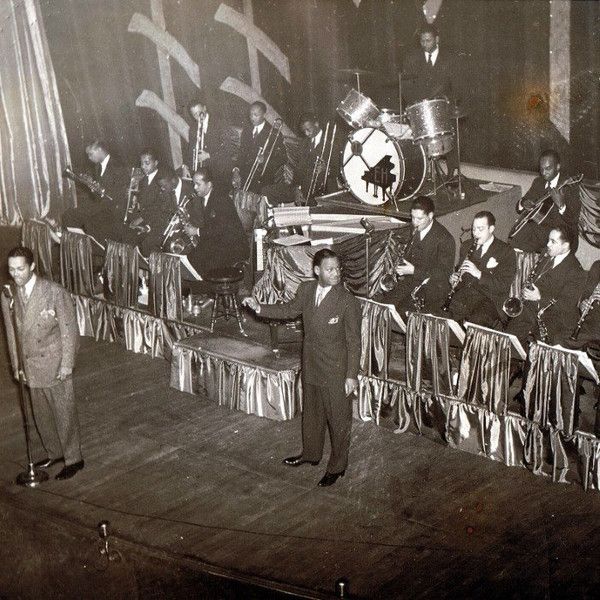
Big Band formed by Earl Hines in 1928 as a rehearsal band while he was appearing with Jimmie Noone's Apex Club Orchestra. The group worked to combine the Hot Chicago sound with the arranged, twelve-piece orchestral big band. The band used many different arrangers. The Hines band usually comprised 15-20 musicians on stage, occasionally up to 28. Among the band's many members were Wallace Bishop, Alvin Burroughs, Scoops Carry, Oliver Coleman, Bob Crowder, Thomas Crump, George Dixon, Julian Draper, Streamline Ewing, Ed Fant, Milton Fletcher, Walter Fuller, Dizzy Gillespie, Leroy Harris, Woogy Harris, Darnell Howard, Cecil Irwin, Harry 'Pee Wee' Jackson, Warren Jefferson, Budd Johnson, Jimmy Mundy, Ray Nance, Charlie Parker, Willie Randall, Omer Simeon, Cliff Smalls, Leon Washington, Freddie Webster, Quinn Wilson and Trummy Young. Occasionally, Hines allowed other pianists to play as "relief" piano player which better allowed Hines to conduct his whole "Organization". Several pianists filled in, such as Jess Stacy, Nat "King" Cole, and Teddy Wilson (Cliff Smalls was his favorite). In 1928 Hines and his orchestra opened at Chicago's Grand Terrace Cafe. For many years, the Hines big band broadcast live from the Grand Terrace, garnering a huge nationwide audience. In 1931, Earl Hines and his Orchestra "were the first big Negro band to travel extensively through the South". Hines referred to it as an "invasion" rather than a "tour". Between a bomb exploding under their bandstage in Alabama (" ...we didn't none of us get hurt but we didn't play so well after that either") and numerous threatening encounters with the Police, the experience proved so harrowing that Hines in the 1960s recalled that, "You could call us the first Freedom Riders". For the most part, any contact with whites, even fans, was viewed as dangerous. Finding places to eat or stay overnight entailed a constant struggle. Hines led his big band for 20 years, right up to the demise of big swing bands in the postwar period. During the WWII years, the Hines band was a hotbed of experimentation and new directions in jazz. Both Charlie Parker and Dizzy Gillespie worked with Hines, as did Benny Carter, Wardell Gray and Gene Ammons. Hines’ featured singers were Billy Eckstein and Sara Vaughan. And Budd Johnson updated Hines' arrangements to reflect the new musical vocabulary of Parker and Gillespie. By the 1950s Hines returned to work with Louis Armstrong on his All-Stars band. Eventually Hines settled in the Bay Area, forming his own Dixieland band.
Data provided by Discogs